

Published: December 2025
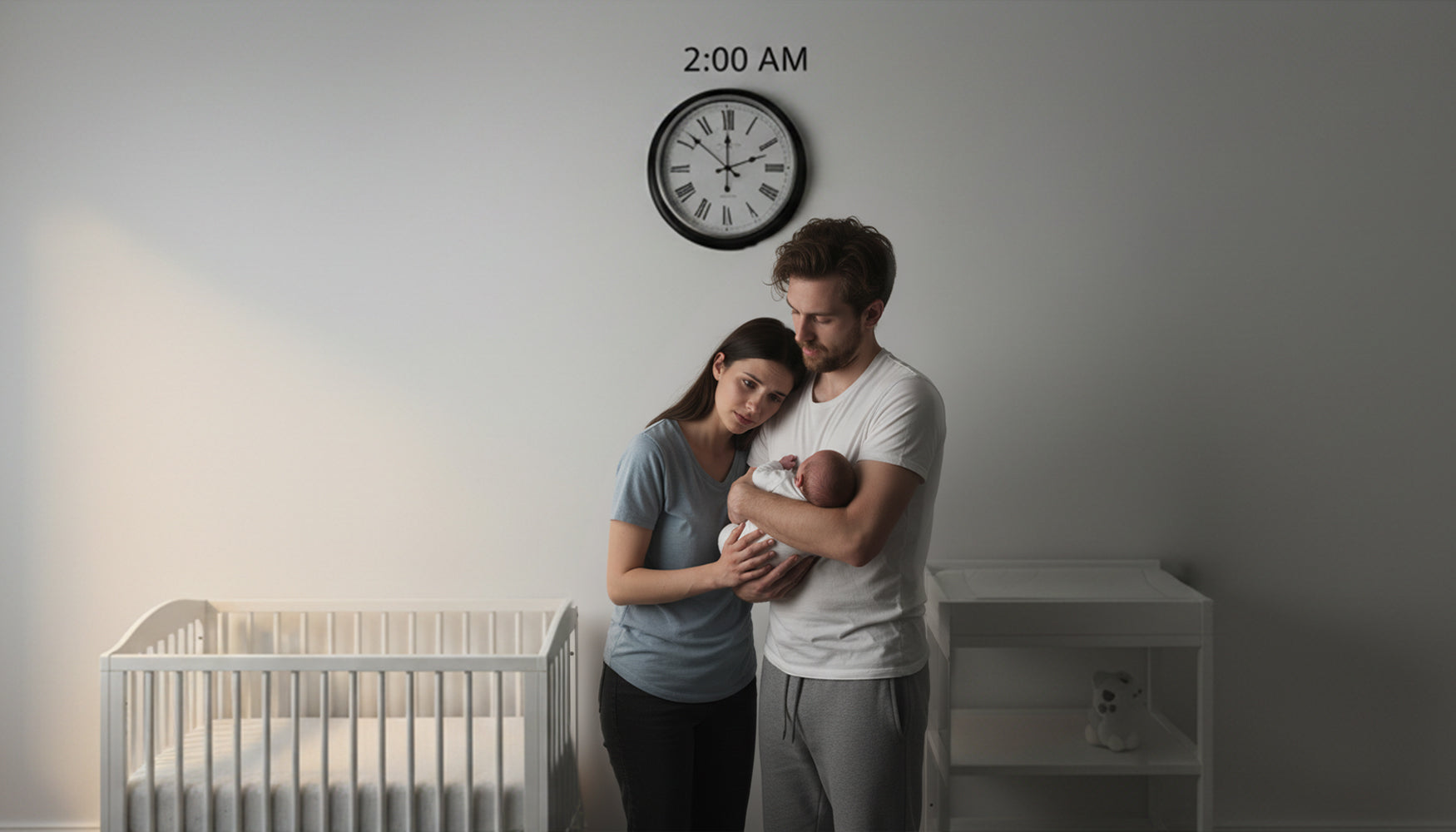
It's 11 PM. You've tried everything. Feeding, rocking, singing, walking, bouncing, that weird shushing sound that worked yesterday—nothing.
Your baby is still crying. You're exhausted. Your nerves are frayed. And you're starting to wonder if you're doing something terribly wrong.
(Spoiler: You're not.)
A 2024 survey of 3,500 new parents found that 89% experienced at least one "nothing works" crying episode in their baby's first six months. You're not alone, you're not failing, and most importantly—there are solutions that actually work.
Let's dive into the techniques that help when your baby won't stop crying.

Why Understanding "Why" Changes Everything
Before we jump to solutions, here's something that transformed my approach: babies cry for specific reasons, even when it seems random.
Research from the National Institutes of Health (2023) identified the top triggers for inconsolable crying:
1. Temperature discomfort - 37%
2. Overstimulation/overtiredness - 28%
3. Digestive discomfort - 19%
4. Need for physical contact - 12%
5. Other (pain, illness) - 4%
Notice something? The #1 reason is something most parents never check properly.
The Temperature Factor Nobody Mentions
Here's what pediatricians know but parenting books often skip: temperature discomfort is the leading cause of unexplained infant crying.
Why Parents Miss This:
You check baby's hands and feet—they feel cool, so you assume baby is cold and add layers. But here's the problem: baby hands and feet are almost always cooler than their core temperature. This is normal circulation development, not an indication they're cold.
The Right Way to Check:
Touch the back of baby's neck or their tummy under their clothing.
What you're feeling for:
· Warm and dry = comfortable ✅
· Warm and sweaty/damp = too hot ⚠️
· Cool or cold = too cold ⚠️
A 2023 study at Boston Children's Hospital found that when parents corrected temperature issues, crying decreased by 64% within 10 minutes.
10 Proven Ways to Calm a Crying Baby (Ranked by Success Rate)
1. The "Temperature Reset" (Success Rate: 73%)
This is so effective it deserves the #1 spot.
Quick check:
· Is baby's neck sweaty?
· Skin clammy or hot to touch?
· Or too cool?
The fix: Remove or add one layer. But here's where most parents struggle: how do you know what's "right" when room temperature keeps changing?
The solution that changed everything for thousands of parents: Temperature-regulating sleepwear.
Unlike cotton (which traps heat) or fleece (which overheats), merino wool automatically adapts to baby's body temperature. When baby is warm, it releases heat. When cool, it provides insulation.
Real parent testimony: "I switched to a Slumberpea wool sleep sack and within two days, the 'mystery crying' stopped. Turns out she was just uncomfortable all along." - Emma T.
Discover temperature-regulating sleep sacks

2. The 5 S's Method (Success Rate: 68%)
Dr. Harvey Karp's famous technique works by triggering baby's calming reflex:
Swaddle - Snug wrapping (arms down for under 4 months)
Side/Stomach Position - Hold baby on their side (never sleep on stomach)
Shush - Loud "shhhh" sound near ear
Swing - Gentle rhythmic motion
Suck - Pacifier or nursing
Pro tip: Do all five at once for maximum effect. One or two alone might not work.
3. White Noise (Success Rate: 61%)
The womb is loud—about as loud as a vacuum cleaner. Silence can actually be unsettling for newborns.
How to use it:
· Volume: 50 decibels (shower sound level)
· Continuous, not intermittent
· Place across room, not next to baby's ear
· Turn on before baby gets hysterical
Apps that work: Hatch Rest, White Noise Baby, or a simple box fan
4. The "Outside Reset" (Success Rate: 58%)
When nothing else works, sometimes you need to break the crying cycle entirely.
The method:
1. Bundle baby appropriately
2. Step outside for 2-3 minutes
3. The temperature change + fresh air often interrupts the spiral
4. Come back in and try soothing again
Why it works: Sensory reset stops the overtired/overstimulated loop.
5. Check for Hidden Discomfort (Success Rate: 54%)
Sometimes crying has a physical cause you haven't spotted:
Quick checklist:
· Diaper clean and dry?
· Clothing tags scratching?
· Hair wrapped around finger or toe? (surprisingly common!)
· Room temperature comfortable?
· Sleep sack or clothing bunched up uncomfortably?
Temperature-related discomfort is sneaky: Even if room temp is "correct," synthetic fabrics can trap heat against baby's skin. Natural, breathable materials like merino wool eliminate this variable.
6. Skin-to-Skin Contact (Success Rate: 52%)
Strip baby down to diaper, hold against your bare chest.
Why it works:
· Regulates baby's heart rate and breathing
· Releases oxytocin (bonding hormone)
· Your body heat naturally adjusts to baby's needs
· Familiar heartbeat sound is calming
Bonus: Works for dads too, not just moms.
7. Rhythmic Motion (Success Rate: 49%)
Babies are used to constant movement from the womb.
What works:
· Gentle bouncing on exercise ball
· Car ride (the vibration + sound combo)
· Baby carrier while walking
· Rocking chair with purposeful rhythm
Key: Consistent, rhythmic motion. Random bouncing doesn't have the same effect.
8. The "Warm Bath Reset" (Success Rate: 47%)
Warm water relaxes tense muscles and changes baby's sensory focus.
Timing matters: Best used before baby is hysterical. Once in full meltdown, the transition might make crying worse initially.
Add: Gentle massage after bath with baby-safe oil.
9. Check Hunger (Even If Recently Fed) (Success Rate: 43%)
Growth spurts happen overnight. Baby might genuinely need more food than they did yesterday.
Signs it's hunger:
· Rooting reflex
· Sucking on hands
· Smacking lips
· Accepting pacifier but still fussy
Try: Offer breast or bottle even if it "shouldn't" be time yet.
10. Remove Stimulation (Success Rate: 41%)
Overstimulation looks like tiredness but needs the opposite treatment.
The fix:
· Dark, quiet room
· Minimal interaction
· No eye contact (sounds harsh, but works)
· Gentle rocking without talking
How to tell if it's overstimulation: Baby arches back, turns away, clenches fists

Age-Specific Soothing: What Works When
0-3 Months (Newborns)
Best techniques:
· Swaddling (stops startle reflex)
· 5 S's method
· Temperature regulation (they can't regulate yet)
· Frequent feeding (growth spurts)
What doesn't work yet:
· Distraction
· Reasoning (obviously)
· Sleep training
3-6 Months
Best techniques:
· White noise
· Rhythmic motion
· Temperature-smart sleepwear (becoming more active = more body heat)
· Beginning of routine recognition
New tool: Transition from swaddle to sleep sack (around 4 months when rolling begins)
Why sleep sacks matter more now: Active babies generate more heat. Temperature-regulating options become crucial. Explore Slumberpea's adjustable sleep sacks
6-12 Months
Best techniques:
· Established routines (babies love predictability)
· Teething relief (if applicable)
· More independence in self-soothing
· Comfort objects (if safe)
Temperature still matters: Babies this age move a lot during sleep, making breathable, adaptive sleepwear even more important.

What to Do When Absolutely Nothing Works
First: It's not your fault.
Some babies have more intense crying periods, especially weeks 2-8 (the "peak crying" period).
If baby is inconsolable for 2+ hours:
Immediate checks:
1. Temperature (one more time)
2. Signs of illness (fever, unusual lethargy, rash)
3. Could this be colic? (crying 3+ hours daily, 3+ days/week)
Self-care checkpoint:
· Put baby in safe place (crib)
· Step away for 5 minutes
· Take deep breaths
· Call for backup if available
· Never shake a baby (frustration is normal, shaking is never okay)
When to call doctor:
· Crying with fever over 100.4°F
· Unusual cry (high-pitched, weak)
· Baby seems in pain
· Crying after fall or injury
· Your intuition says something's wrong
The Hidden Crying Trigger Most Parents Overlook
After working with thousands of parents, here's what we've learned: the most overlooked crying trigger is chronic temperature discomfort.
It's not dramatic. Baby isn't burning up or freezing. They're just... slightly uncomfortable. All day. Every day.
The problem with traditional baby clothing:
· Cotton holds moisture (damp = uncomfortable)
· Synthetics trap heat (can't breathe)
· Both require constant outfit changes as temperature fluctuates
Why this causes crying:
· Baby can't tell you "I'm a bit warm"
· Discomfort builds gradually
· By the time they're crying, they're already stressed
· You check temperature, it seems "fine," but baby is still uncomfortable
The solution that's transforming baby sleep:
Temperature-regulating sleepwear made from natural merino wool. It sounds simple, but the impact is profound.
How it works:
· Automatically releases heat when baby is warm
· Traps warmth when baby is cool
· Wicks moisture away from skin (stays dry)
· Works across 63-75°F room temperature range
· No guessing, no outfit changes, no temperature-related crying
Real impact: Parents using Slumberpea wool sleep sacks report 40% fewer crying episodes related to discomfort.

Quick Troubleshooting: Specific Crying Scenarios
Crying After Feeding
Likely cause: Gas, reflux, or overfull tummy
Try: Burp more frequently, hold upright 20 minutes, bicycle legs
Crying During Diaper Change
Likely cause: Cold air on skin, startle from position change
Try: Warm wipes slightly, keep room warmer, distract with toy
Crying in Car Seat
Likely cause: Restriction, boredom, or temperature
Try: White noise, mirror for eye contact, check if overheating
Inconsolable Evening Crying ("Witching Hour")
Likely cause: Overstimulation from full day
Try: Dark room, minimal stimulation, earlier bedtime routine
The Long-Term Solution: Prevention
Here's the truth: While you can't prevent all crying, you can eliminate many triggers.
The highest-impact changes:
1. Consistent temperature comfort (biggest single factor)
2. Regular feeding schedule
3. Age-appropriate wake windows
4. Predictable sleep environment
5. Quality sleepwear that adapts to baby
Why #1 matters so much: Temperature affects everything—sleep quality, feeding, mood, growth. Get this right, and other things become easier.
Your Next Step
If your baby won't stop crying and you've tried everything on this list, there's one more thing to check: are they truly comfortable?
Not just "not in pain"—but genuinely, physically comfortable in what they're wearing and sleeping in?
The parents who stress least about crying have one thing in common: They eliminated the temperature variable entirely.
Ready to experience the difference?
Discover Slumberpea's Temperature-Regulating Sleep Sacks
Every purchase includes:
· Room thermometer + dressing guide
· 30-day comfort guarantee
· Real parent support team
Because when baby is comfortable, everyone can finally breathe.


